Australia's largest behavioural experiment
TheBehaviourChange
Experiment
The Behaviour Change Experiment is turning everyday recycling into something rewarding, measurable, and impossible to ignore — recovering Australia's 4 billion lost containers.
How fast can Australia change behaviour when doing good becomes rewarding, visible, and shared by millions?
4B
containers lost/yr
10M+
Target participants
3,957,482,146

I've never been more dedicated to anything in my life. I'm all in.
A personal message from me


Matty Gee
Founder
Hey 👋 I'm Matty Gee, and I'm on a mission to help people and the environment while spreading love and kindness 💚
I can't just sit and watch 4 billion beverage containers being littered and going to landfill across Australia each year, so I'm doing something about it — and I'm doing it in a big way.
What better way than to rally over 10 million Australians behind the Behaviour Change Experiment — Australia's largest behavioural experiment. The Experiment powers the 10c Recycling Games, an ongoing game module inside pleyr-x — a gaming layer that sits on top of the container deposit scheme, allowing people to opt in and direct their refund toward a central prize pool worth hundreds of millions of dollars — in exchange for game points and the chance to win a share of it once the Games are live and fully licensed. This is how you change behaviour and fund causes to help people along the way.
This is my answer, and it's Australia's answer to a problem we all contribute to — and I won't stop until every single one of those 4 billion containers has a reason to come home to the container deposit scheme.
4B
containers I'm fighting to save every year
10M+
Australians I'm rallying to this movement
Day 1
I've been all-in — no backup plan, no half measures
My promise to Australia
"I will fight for every single one of those 4 billion containers until they have a reason to come back."
— Matty Gee
4 billion containers.
To litter and landfill. Every year.
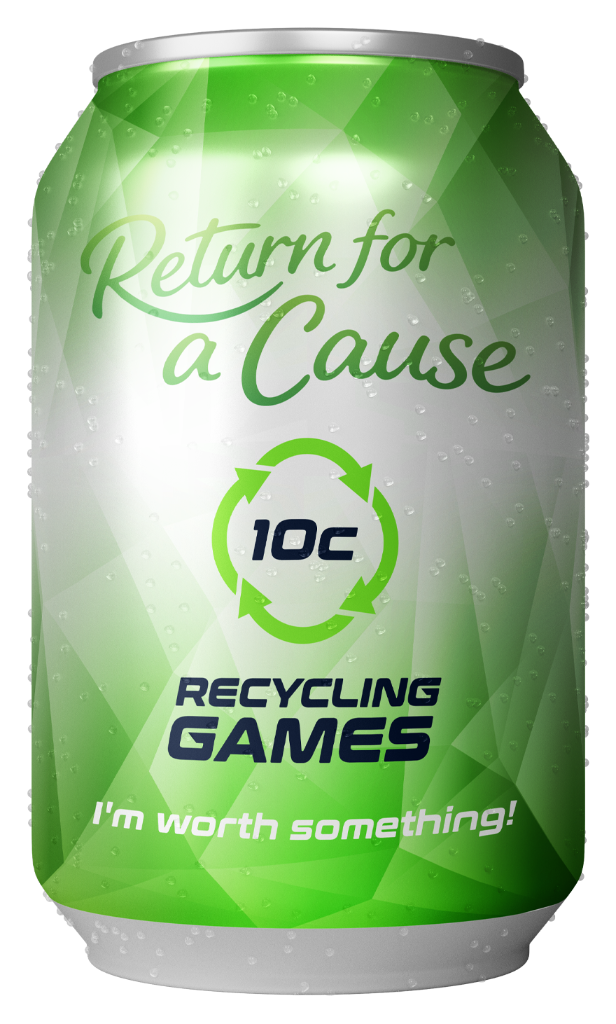
Of the 12 billion-plus eligible 10-cent beverage containers sold in Australia each year, around a third never come back — ending up as litter on beaches, in waterways, and in landfill. That's around 4,000,000,000 containers. The Behaviour Change Experiment exists to change that.
Containers lost to litter & landfill annually
~4,000,000,000
And this number grows every single year the scheme fails to hit 85%.
19×
Around Australia's entire coastline
Tracing every bay, inlet and headland of Australia's 35,877 km official mainland coastline — measured by Geoscience Australia. Nineteen times over.
17×
Around the entire Earth
Enough to wrap the planet — oceans and all — seventeen times with discarded bottles and cans.
To the Moon + 90% back
If stacked end-to-end into space
At 170mm per container, 4 billion containers reach the Moon — and most of the way home again.
2,686×
Covering the MCG playing surface
The MCG oval averages 171m long × 146m wide (24,966 m²). This would bury the ground under 148 metres of containers — taller than a 40-storey building.
The Behaviour Change Experiment is here to recover those containers.
By making participation rewarding, measurable, social, and nationally visible — we're turning Australia's biggest recycling failure into its greatest opportunity.
What is the Behaviour Change Experiment?
Our community and environment need our help. That's why we're launching the Behaviour Change Experiment — Australia's largest behavioural experiment — with a goal of rallying over 10 million people to play the 10c Recycling Games to ensure the remaining 4 billion beverage containers are returned, which will fund positive impact nationwide.
Litter on beaches & roadsides
Buried in landfill
Powered by the 10c Recycling Games, built around:
An extra ~1.2B are lost to kerbside loopholes — where consumers don't see the money, but they're counted in the scheme.
4B+
containers lost/yr
10c
per container
The Behaviour Change Experiment was created to test one thing:
Whether Australia can solve the participation problem at national scale to reach the return target. Because infrastructure alone doesn't drive behaviour, larger incentives do.
● Est. — Right Now
609
containers lost to litter & landfill since opening this page — 127 per second
The goal is simple: recover the 4 billion 10c containers still being lost every year.
Why Does It Exist?
Australia's container deposit schemes were designed to improve recovery outcomes. But the current system has reached a point where infrastructure alone is no longer enough to achieve the targets Australia is aiming for.
Old challenge
Awareness
Most Australians already support recycling.
The real challenge
Participation
Far fewer consistently engage with the return process.
That's the gap the Behaviour Change Experiment is designed to address. The initiative applies proven behavioural science principles to environmental action by making participation:
Because when behaviour becomes engaging, participation increases. And when participation increases, recovery outcomes improve.
~33%
of eligible containers never returned each year
85%
national recovery target — still not reached
$520M+
in unclaimed & diverted deposits annually (CDS + MRF kerbside)
$520M+ = ~$400M in CDS unclaimed deposits (est. 4B unreturned containers × 10c, based on ~12B containers sold nationally — Boomerang Alliance / ABCL) + ~$120M in MRF kerbside redirected deposits (our analysis of state annual reports). $1.2B = total 12B eligible containers × 10c.
"I didn't build this because it was the easy thing to do. I built it because I genuinely believe Australia can solve this — and I'm the one willing to go all-in to prove it."
Why Are We Doing It?
We all share a responsibility to the environment we inhabit. It is our duty to ensure that what has been manufactured is recycled and reused — looking after the planet for future generations.
Every lost container represents:
Lost material recovery
Aluminium, glass and plastic that could re-enter the circular economy.
Lost environmental value
Each container recovered is one less piece of litter or landfill.
Lost economic potential
Billions in refund value that never flows back to communities.
$1.2B
refund economy
4B+ lost/yr
Containers
$520M+ diverted
Deposits
$500M+ potential
Opportunity
The hidden opportunity
At Scale — The Numbers
$10M+
per week in cash, prizes & rewards (projected at full scale)
$1.2B+
annual container refund economy
$500M - $800M
projected annual prize pools at full scale
The Opportunity — At a Glance
0B+
containers lost to litter & landfill annually
$0M+
in unclaimed & MRF-diverted deposits every year
$1.2B+
annual container refund economy
$0M+
projected annual prize pool at full scale
How is $520M+ calculated? ~$400M in CDS deposits go unclaimed each year (containers never returned), plus ~$120M collected through kerbside — your household recycling bin. When eligible containers go into the recycling bin, councils sort them at a Material Recovery Facility (MRF). The MRF claims the 10c deposit, but the consumer who originally paid the deposit never sees that money back. The Behaviour Change Experiment changes this by incentivising people to return through CDS instead — keeping the refund value in consumers' hands.
Transforming passive recycling into active participation.
The 10c Recycling Games connects environmental action directly to incentives, rewards, competition, and measurable outcomes — making it easier for Australians to do the right thing.
Creating opportunities, not handouts.
The initiative creates new participation opportunities for Australians navigating increasing cost-of-living pressure — through incentivised environmental participation connected to real-world recovery activity.
How Does It Work?
Australians return eligible 10c beverage containers through existing CDS infrastructure. The 10c Recycling Games transforms those returns into a live national participation experience.
Collect eligible 10c beverage containers
Return them through existing CDS infrastructure in your state
Record participation through the 10c Recycling Games
Earn game points based on verified recycling activity
Contribute toward prize pools and national milestones
Help drive measurable environmental and social impact
Participants contribute toward:
Massive prize pools
Live milestones
National targets
State rankings
Impact funding
Conservation
Community support
Environmental legacy
Massive prize pools
Live milestones
National targets
State rankings
Impact funding
Conservation
Community support
Environmental legacy
The more containers recovered, the more participation grows. The more participation grows, the larger the impact becomes — creating something entirely new: a large-scale incentive economy built around urban mining, circular recovery, and behavioural participation.
What Are We
Measuring?
This isn't just measuring recycling activity. It's measuring behavioural participation at national scale.
● The Central Question
How many additional 10c beverage containers can Australia recover when participation becomes rewarding, visible, and nationally engaging?
Live.
Not twelve months later in a report — as it happens, in real time.
Measurable.
Live dashboards, milestone systems, and impact counters tracking every return.
Participants also help identify whether returned containers would have otherwise gone to landfill, become litter, entered kerbside recycling, or already been returned through CDS — allowing the initiative to measure behavioural uplift and recovery impact in real time.
Why Does It Matter?
Incentivised environmental action
Pioneering a new model that rewards people for doing good — at national scale.
Participation-driven recovery
Testing whether large-scale participation systems can reshape environmental outcomes.
Behavioural economics
Applying proven science to environmental action — making the right thing to do the rewarding thing.
Circular economy mobilisation
Unlocking billions in economic and environmental value currently going to waste.
Urban mining at scale
Turning discarded containers into a national recovery asset — not a disposal problem.
Community participation economy
Connecting millions of Australians to measurable environmental impact through simple daily actions.
If millions of Australians can be mobilised around one simple behaviour at national scale, the model has implications far beyond recycling alone.
That is what makes this experiment significant. It's testing whether large-scale participation systems can help reshape how environmental and economic value are created together.
"The 4 billion containers are just the beginning. I see a world where every piece of recoverable material has a reward attached to it — and Australians are the ones making it happen. That's the future I'm building."
What Happens If It Works?
The 10c Recycling Games is the proof of concept. If it works, it unlocks something far bigger — Australia's largest untapped urban mining opportunity.
Phase 1 — The Entry Point
10c CDS
Beverage containers. One stream. Proof of concept.
scales to
Phase 2 — Full Scale
Urban Mining
Every recoverable material stream in Australia.
E-Waste
$4.2B
Prec. Metals
Gold, silver, Cu
Aluminium
Cans & foil
Batteries
All types
Tyres
End-of-life rubber
Plastics
All streams
Appliances
White goods
Steel
Scrap metal
Textiles
Clothing & fabric
The Urban Mining Market — Australia
$12B+
annual recoverable material value sitting in Australian waste streams
$4.2B+
e-waste commodity value discarded every year — the fastest-growing stream
60%+
of recoverable materials never re-enter the circular economy due to participation failure
$1.2B+
annual container refund economy — the proof-of-concept already exists
What full-scale urban mining unlocks
Material Recovery at Scale
Aluminium, steel, glass, plastics, e-waste, and batteries — recovered from Australian households and redirected into manufacturing supply chains. Billions in dormant value, activated.
A Self-Funding Prize Economy
Commodity recovery value funds the prize pool. The more Australians recover, the larger the prizes. The incentive system scales with the market — no subsidies required.
Australia's Circular Economy Engine
Not a campaign. Not an app. A permanent behavioural infrastructure layer — connecting millions of Australians to every recoverable material stream, rewarding every return.
● TRANSMISSION — URBAN MINING INITIATIVE
The Behaviour Change Experiment is the entry point. The 10c Recycling Games builds the behavioural infrastructure. Urban mining is the destination — and it's a multi-billion dollar opportunity hiding in plain sight.
"This is the power move the world needs — and it starts right here in Australia. There's not a single behaviour change program on the planet that can shift the circular economy at the scale I'm talking about. Until now. I'm not just building something new. I'm building what's been missing."
Transparency in Action
Watch It Happen Live
No reports. No waiting. No surveys. Every container counted. Every return measured. Every cause funded in real-time.
Social & Environmental Impact
The Behaviour Change Experiment turns container returns into measurable national impact — for communities and for the environment across Australia.
Social Impact
Beyond environmental benefits, the Behaviour Change Experiment supports community-driven social initiatives. Every container return contributes to our selected causes and the causes nominated by participants across Australia.
Environmental Impact
Australia faces a critical waste crisis. Every year, billions of beverage containers contribute to landfill overflow, ocean pollution, and carbon emissions. The Behaviour Change Experiment directs participation into large-scale environmental recovery.
Our team is actively working on impact targets, measurement frameworks, and delivery partners. Specific commitments will be published as they are finalised.
How to Participate
The Behaviour Change Experiment is now inviting expressions of interest from organisations, communities, partners, and supporters who want to help launch Australia's largest behavioural experiment.
Participation is open to
Sign up as a solo player or join a team
Get your unique player number linked to your state CDS system
Return containers at any CDS depot or reverse vending machine
Log your returns using your player number
Earn points for every verified return
Play to win — contribute to prize pools & track your impact
begins here.
Welcome.
You're part of something historic.
Join the other projected 10 million Australians as we change the circular economy forever.
10M+
Projected participants
4B
Containers to save
∞
Our commitment to this
"I started this because I couldn't accept that 4 billion containers just disappear every year while the system shrugs. I'm not stopping. I'm not slowing down. And now that you're here — neither are you."
There's more to discover.
Dive deeper into the data, the games, and the debate shaping Australia's recycling future.
Want to understand why this works?
We've mapped the exact neurochemical systems that make the 10c Recycling Games one of the most powerful drivers of human behaviour ever designed into an environmental program.

Important Legal Disclaimer
Please read and acknowledge these terms before continuing.