
Tim, you saw the opportunity early.
The initiative has grown.
The opportunity is now much larger.
When we met at WARRRL's office in July 2025, you understood and loved the idea immediately. We appreciated that — and we kept building. Ten months on, what was a strong proposal has become a national movement, and we're reaching out again because Western Australia still has the opportunity to lead it.
This page is a briefing — not a debate. It outlines where the platform sits today, why the participation gap still requires a behavioural solution, and why a WA partnership remains the most strategically natural place to start.
The Current Reality
Where the scheme stands — and what the data shows
65.6%
Current recovery rate
FY2024-25 Annual Report
85%
Statutory target
Set by WA government
19.4%
Gap to close
~533M containers per year
+0.6%
Year-on-year growth
Infrastructure maturity is real
Infrastructure is mature. The participation gap is behavioural.
WA now has 303 refund points, a well-established app, Drop and Go services, and one of the most accessible CDS networks in the country. Eight in ten adult Western Australians have already participated. The remaining gap is not an access problem — it is a participation motivation problem. Your own 2025-2027 Strategic Plan identifies this directly: embedding behaviour science principles and driving out-of-home participation are the named next levers. That is precisely what we are built to deliver.
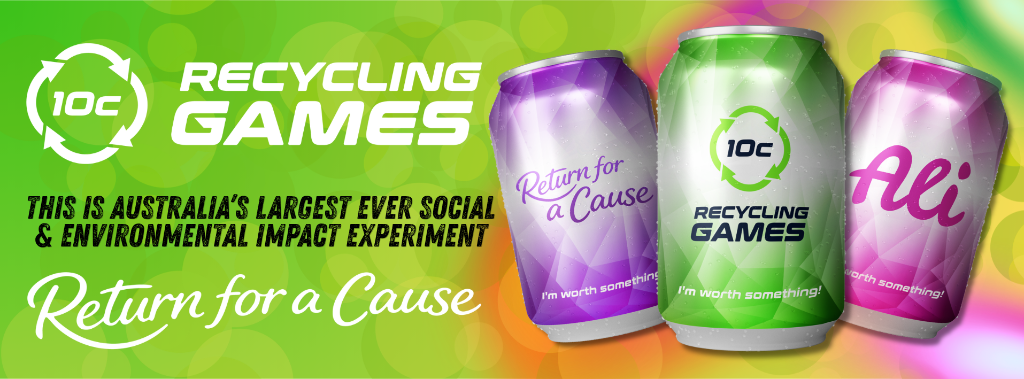
Return for a Cause — Australia's largest ever social and environmental impact experiment.
The 10c Recycling Games has evolved into Return for a Cause — a nationally framed movement that connects container returns to real prizes, community causes, and measurable environmental outcomes.
Every container returned stays out of landfill. Every return contributes to social and environmental causes. And the engagement mechanics — leaderboards, team challenges, prize pools, community impact tracking — create the sustained participation motivation that infrastructure alone cannot generate. This is the behavioural layer the CDS ecosystem is missing.
Return for a Cause
Turn your 10c refund into real social and environmental impact.

Environmental impact
Every container returned is one less piece of litter and landfill — measurable recovery at national scale.
Social impact
A percentage of returns flows to community causes — built into the participation itself, not bolted on.
National significance
A named national experiment with real prizes, real players, and real stories — the narrative power recycling alone cannot generate.

Your own strategic plan is our brief.
WARRRL's 2025-2027 Strategic Plan identifies the participation gaps we are built to close. These are direct quotes from your published plan — alongside what we deliver against each one.
WARRRL's Strategic Plan
Achieve 85% container recovery rate (Strategic Plan 2025-2027 Primary Goal)
Our solution
Drive the remaining participation gap through behavioural incentives, gamification, and community engagement — the tools infrastructure alone cannot deliver.
WARRRL's Strategic Plan
Drive 'out of home' participation — hospitality, retail, events, mining (Strategic Plan 2025-2027, Pillar 2c)
Our solution
Target precisely these sectors through team-based participation, business challenges, and event activations. Out of home, 10c feels like a burden — but points toward a life-changing prize feel like an opportunity worth holding onto.
WARRRL's Strategic Plan
Embed behaviour science principles to deliver increased participation (Strategic Plan 2025-2027, Initiative 2a)
Our solution
Behavioural science is the foundation of our model — gamification, variable reward schedules, social proof, streaks, and community identity.
WARRRL's Strategic Plan
Compelling member experience and strong social impact brand (Strategic Plan 2025-2027, Values and Pillars)
Our solution
Every participant can support a cause, earn rewards, and contribute to measurable community and environmental outcomes — social impact embedded by design.
WARRRL's Strategic Plan
Increase participation incentivisation and harness loyalty for Containers for Change brand (Initiative 2b)
Our solution
Prize draws, leaderboards, charitable giving, team competition — all driving loyalty and repeat behaviour within the existing C4C brand.
Why 10c fails out of home — and why points don't.
The Inconvenience Barrier
Carrying a container while out and about is a friction-heavy behaviour. The only reward is 10c — and the perceived inconvenience of holding onto that container easily exceeds that value. Behaviourally, it feels like it costs you more than you get back.
10c
feels like it costs $10
The Opportunity Shift
When one container equals 10 points and you're competing for life-changing prize draws, the calculus flips entirely. You're no longer getting a measly 10c — you're investing in a win. The container becomes an active asset worth taking home, not a burden.
Points
are a game currency to win
The Result
Participation in hospitality, retail, workplaces and event spaces rises — not because the 10c refund changed, but because the meaning attached to the action changed. That is the behavioural gap the existing scheme cannot close on its own.
Same container.
Completely different behaviour.
A clean division of responsibility.
The 10c Recycling Games is complementary infrastructure — not competitive infrastructure. WARRRL continues doing exactly what it does. We add the participation engine it feeds.
WARRRL
Continues doing exactly what it does now
- Operate the physical refund point network (303 locations)
- Process returned containers through refund point operators
- Manage logistics, processors and recyclers
- Pay refunds, manage FRS contributions
- Maintain compliance, fraud detection, scheme integrity
- Run the Containers for Change brand
The 10c Recycling Games
Owns and operates the engagement layer
- Build, own, and operate the consumer engagement platform
- Design and run all behavioural incentive mechanics
- Manage the national prize pool and draws
- Run social and environmental cause programs
- Drive participation among those not motivated by 10c alone
- Bring more containers to the network — WARRRL processes them
No operational burden. No systems change. No new team required.
The CDS ecosystem's strongest schemes operate the physical network with precision. The 10c Recycling Games adds the engagement layer they don't need to build — driving more returns to the existing infrastructure. The division is clean, complementary, and entirely additive.
You understood the opportunity
the moment we walked in the room.
The July 2025 meeting confirmed a genuine alignment between what WARRRL needs and what we've built. These are the key moments from that conversation — included here not as pressure, but as a reminder of where the shared thinking already landed.
From the meeting
"The Recycling Games would absolutely help Containers for Change reach the demographics they can't reach — the ones that are disengaged."
This confirmed the exact participation gap the platform is designed to close — the people infrastructure alone doesn't reach.
From the meeting
"We only have 25% of participants with a member number — this would help us get more sign-ups."
Member registration is a key strategic metric. The 10c Recycling Games requires account creation by design — it addresses this directly.
From the meeting
"We could fund an initial prize pool rollout to drive behaviour — run it as a pilot model."
A pilot model funded through unclaimed refunds remains a practical and low-risk entry point. The structure hasn't changed.
From the meeting
"It's a yes from me — but I'll need to speak with the team first."
Your personal read of the opportunity was clear. We understood that the team conversation was a necessary next step — and we respect that process.
Follow-up Email — 14 August 2025
Tim Cusack → Matty Gee
The team's position following internal review
"Thank you again for thinking of Containers for Change and for sharing your vision. We'll keep your details on file and will be in touch if the timing and focus align in the future."
We appreciated the response — and we understood the timing wasn't right. Ten months on, we're reaching out again because the platform has grown considerably, the national movement is forming, and the participation gap remains. The door is open from our side.
The CDS is just the entry point.
This is a multi-billion dollar circular economy behavioural incentive play.
We've spent ten months building the case for the CDS — because it's the proof of concept, the entry point, and the simplest version of the argument. But it would be a mistake to think that's all this is.
The same incentive model — the same behavioural engine, the same points system, the same prize pool — is already being designed to cover every recoverable material stream in Australia. E-waste, batteries, scrap metal, soft plastics, white goods, textiles. Every item an Australian household accumulates and eventually discards. Every one of them has a wholesale commodity value. Every one of them has a participation gap caused by zero consumer incentive. That is precisely where we operate.
Mining the Modern World's Riches from our homes
E-waste, batteries, rubber, metals, plastics, textiles — billions in recoverable value hiding in plain sight in cupboards, draws, sheds etc. We're extracting it, returning it, and funding the future with it.
Discover Urban Mining
Designing a Waste-Free Future with circularity
Moving beyond 'take-make-dispose' to a regenerative system where every resource that can be recovered, is. The circular economy isn't just an environmental framework — it's an economic one.
Explore CircularityTim — what this means for you
Western Australia is not just a CDS jurisdiction.
It is the first state in a national circular economy transformation.
WARRRL's job is to manage the container deposit scheme — and that job is important. But the organisation that partners with us on the CDS becomes the first to participate in a platform that will — by design — expand to every recoverable material Australians generate. The relationship we are proposing for the CDS is not a one-off engagement. It is the entry point into an ecosystem that has no ceiling.
This is not a company asking you to let us add a gamification feature to your app. This is a circular economy infrastructure play at national scale — and we are building it whether any individual coordinator joins or not. The question is whether Western Australia leads it, or watches other states go first.
We're not waiting for anyone this time.
We're launching.
We are actively presenting to multiple states simultaneously. WA is on the table. Queensland is on the table. We're not holding the launch for any single decision — we're moving forward with whoever is ready to lead.
When the countdown reaches zero, we go public — launching the Expression of Interest for Australia's Largest Ever Social & Environmental Impact Experiment with or without a state partner locked in.
Time Until Media Submissions
We're not applying pressure, we're just keeping a tight schedule.
This countdown exists because every single day this is delayed, almost 11 million beverage containers end up as litter or in landfill. This isn't about urgency for urgency's sake — it's about accountability to the environment and to every Australian who deserves better.
Tim — you already know the answer.
You said it yourself, in that room.
"It's a yes from me." Those were your words on 2 July 2025. Not polite interest. Not cautious openness. A yes. The data was compelling then. It is more compelling now. The gap to 85% hasn't closed. The containers keep going to landfill.
We're not asking you to take a risk. We're asking you to follow through on a decision you already made — one that your own strategic plan, your own performance data, and your own words on the day all support.
The numbers don't change while we wait
~44 million containers to landfill every month. ~$4.4M in forfeited refunds. Every month.
~333 million containers littered and going to landfill every month across Australia. ~$33M in forfeited refunds — over $400M every year. Over 4 billion containers lost to litter and landfill annually. Not one single behaviour change program running anywhere in the country.
Tim — before you reply, please read these in full
These pages were built specifically around the data you need to see. Data on the audit page is sourced from WARRRL's own reports and public records.
WILL WARRRL LEAD THE NATION OR FOLLOW WHEN OTHERS DO?
Want to understand why this works?
We've mapped the exact neurochemical systems that make the 10c Recycling Games one of the most powerful drivers of human behaviour ever designed into an environmental program.

Important Legal Disclaimer
Please read and acknowledge these terms before continuing.